
Digital Cowboy / CYOG Podcast / AI Mastermind AfterShow
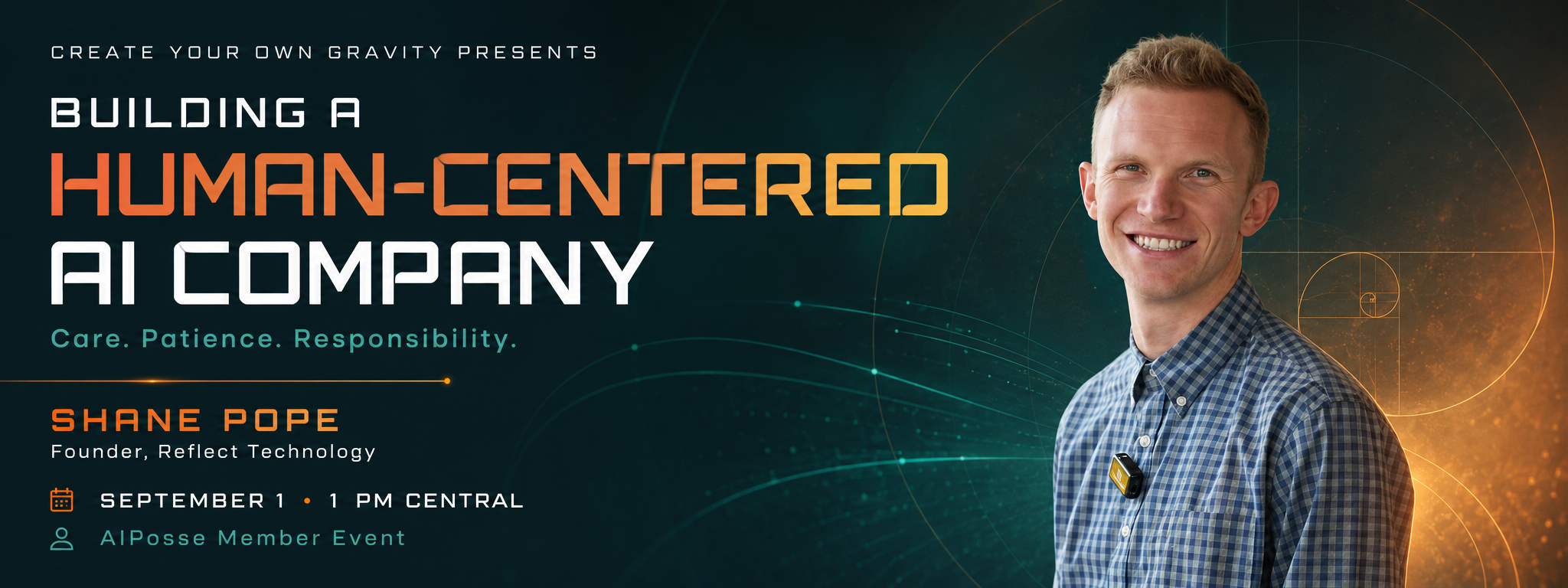
Human-Centered AI: Keep Your Judgment with Shane Pope
Create Your Own Gravity (CYOG) podcast · AI Mastermind AfterShow · Hosted by Joe Moore and Katrena Drake.
Human-Centered AI: Keep the Human in Control | Shane Pope
AI can answer almost any question. That does not mean it should become the authority.
That distinction sits at the center of this Create Your Own Gravity AfterShow conversation with Shane Pope, founder of Reflect Technology and creator of Remi. While much of the AI market is racing to provide faster answers, stronger recommendations, and more convincing certainty, Shane is building in the opposite direction. Remi asks questions designed to help people hear their own thinking more clearly.
Shane’s approach shows what human-centered AI looks like when the human remains the authority.
Katrena Drake led the conversation through the choices beneath the product: why Shane started it, why he is growing it carefully, what he is protecting, where the guardrails belong, and what a more human-centered AI company might look like. The result is more than a product discussion. It is a founder’s argument for keeping human judgment at the center of the system.
That argument matters now. When an AI system sounds confident, the easiest move is to hand it more authority than it has earned. Human-centered technology begins by reversing that drift: technology should support a person’s capacity to think, decide, and relate—not quietly replace it.
Who was in the room
Shane Pope was the featured guest. He is the founder of Reflect Technology and the creator of Remi, a structured reflection tool built around a bounded sequence of AI-guided questions.
Katrena Drake guided the interview. Her questions created the path through Shane’s product philosophy, safety decisions, company-building strategy, and larger vision for technology. Joe Moore hosted the room, while Jeff Valin supported the technical side of the session. The substance of this article comes from Shane’s answers.
This was also not Shane’s first appearance in the Digital Cowboy ecosystem. His earlier conversation about meta-cognition in the age of AI (article in preparation) introduced the deeper territory: what happens to human thought when machines become increasingly fluent at thinking beside us?
The question beneath the conversation
What changes when AI is designed to return authority to the person using it?
Katrena approached that question from several directions. Why build a tool that asks instead of tells? Why contain the experience rather than make it endless? Why resist premature scale? Why involve mental-health professionals before pursuing aggressive user growth? Why call the product a thought partner rather than a therapist or coach?
Each question exposed the same underlying choice. Shane is not trying to make AI feel more human so users will form a deeper attachment to it. He is trying to create enough structure for people to become more present to themselves.
Human-Centered AI That Keeps You in Control | Shane Pope
The dominant promise in AI is convenience. Ask a question and receive an answer. Describe a problem and receive a plan. Express uncertainty and receive something that sounds certain.
That can be useful. It can also train people to outsource the exact capacity they most need to strengthen: judgment.
Shane described Remi as reflective processing technology. The system does not present itself as the genius in the room. It prompts the user to examine an experience, decision, tension, or memory, then follows the user’s own language deeper.
— Keep the human at the center
“With mine, because it’s asking you questions, it’s keeping you as the authority. It’s keeping you at the center of it.”
Learn more about Shane Pope · Explore Remi
This is the core difference between assistance and replacement. A human-centered AI tool can help someone slow down, notice a pattern, or name what they already know without claiming the right to decide for them. The technology creates a container. The person supplies the meaning.
Seven questions create a beginning, middle, and end
Remi is deliberately not a free-flowing chatbot. A user selects a reflection path, answers an opening question, and moves through a structured sequence. Seven questions is the current center of the experience, with shorter and longer options under consideration.
The number itself is less important than the boundary it creates. Open-ended chat can become disorienting because there is no natural signal that the exchange is complete. The system can always ask another question. The user can always reveal another layer. Engagement becomes its own momentum.
Shane’s design introduces closure. There is a clear start, a middle, and an end. That makes the interaction easier to understand and harder to confuse with an ongoing relationship. It also respects the user’s attention by refusing to make endless engagement the measure of success.
That philosophy connects with the larger concern explored in the conversation about surveys becoming AI agents (article in preparation): the shape of an interaction changes what people disclose, what they expect, and who they believe is listening. Interface decisions are never merely technical. They establish the terms of trust.
Shane is protecting the foundation before chasing scale
Katrena asked why Shane was choosing a slower, more natural launch path. His answer revealed a founder who sees restraint as part of product quality.
Before pursuing user acquisition, Shane ran clinical pilot work with mental-health professionals. The findings led him to pull the app from the store while the team rebuilt its safety layer. He also identified product features that needed to exist before the experience was ready for consistent paid use.
That choice carries an immediate cost. Delaying growth can feel like falling behind, especially in an AI market trained to reward speed, funding announcements, and visible traction. Yet acquiring users before the product is safe, useful, and economically coherent can multiply the wrong thing. More users create more cost, more exposure, and more reputational risk.
— Give the company room to become
“I’m giving my company the space to learn and become what it really is by not forcing deadlines and forcing milestones and allowing it to grow and evolve at its natural pace, because I think of companies as living organisms and they learn and they grow.”
Learn more about Shane Pope · Explore Remi
There is a time for speed and a time for learning. Shane is protecting the learning phase so that scale does not harden the wrong positioning, the wrong product behavior, or the wrong promise. He compared the process to preparing land for a skyscraper: the visible height matters later; first, the ground has to hold.
This is clarity before scale. It is not an excuse to hide forever. Shane described a specific inflection point: an enterprise backend supported through an AWS partner program, stronger data handling, a comprehensive rebrand, and a clearer path to market. Patience only becomes strategy when it is attached to evidence and milestones.
Guardrails must live inside the product
The most important boundaries in Remi are structural. Users cannot turn it into an endless companion. The system redirects questions back toward reflection. It does not present itself as a person. It does not currently build a persistent map across unrelated areas of the user’s life. Each session begins with a reminder that the interaction is with AI.
Shane also drew a bright line around crisis use. Remi is not designed for moments when someone may be in danger of harming themselves or another person. A dedicated safety layer reviews interactions for signs of serious risk and directs users toward appropriate outside resources when that threshold is detected.
Those decisions show why ethical AI cannot be separated from product design. A disclaimer placed at the edge of an experience is not the same as a boundary built into the experience. If a product’s business model rewards dependency while its terms warn against dependency, the real design is revealed by the incentive.
— Safety evolves with what we learn
“All we can do is build the safest tool with the information we have.”
Learn more about Shane Pope · Explore Remi
That sentence carries humility without surrendering responsibility. No founder can promise that a new system will never fail. A responsible founder can seek qualified input, test assumptions, respond to evidence, create escalation paths, and keep improving the boundary as new information arrives.
Shane described working with a fractional chief scientific officer and a clinical advisory council of practicing therapists. Their role is not decorative credibility. It is part of an information loop that helps the company understand where the product belongs, where it does not belong, and what safer design requires next.
A thought partner is not a therapist
Language determines what users expect from a system. Calling an application an AI therapist implies clinical authority, therapeutic competence, and a kind of relational role the technology may not be able to hold safely. Shane has chosen a narrower frame: Remi is a thought partner for structured reflection.
That distinction is strategically useful because it is ethically honest. It allows the product to support people who want to think through a decision, unpack an experience, or find clarity without pretending to diagnose, treat, or replace professional care.
It also changes the relationship with therapists. Shane observed that mental-health professionals are not necessarily resisting technology because they fear replacement. Many recognize the demand problem and are open to useful tools. Their resistance sharpens when companies make clinical claims before earning clinical trust.
The category is therefore part of the guardrail. Remi sits closer to journaling and meditation than therapy. It can help a person arrive at a human conversation with greater clarity; it is not meant to become the human relationship.
The human revolution asks whether progress still serves us
Shane’s product choices connect to the larger idea behind his TEDx talk, “It’s Time for a Human Revolution.” He is not anti-technology. He is building an AI company because he believes technology can support human growth.
His challenge is aimed at inevitability. Moving forward technologically does not remove the responsibility to step back and ask whether the direction still serves people. Progress is not only the ability to build the next system. It is the ability to examine what the system trains us to become.
That same philosophy shapes how Shane wants to finance and grow Reflect Technology. He is looking for aligned investors, business leaders, and cultural partners who can help build credibility and reach without importing the assumption that a legitimate AI company must begin by burning millions of dollars.
The experiment is both technical and economic: can the right people, in the right rooms, make reasonable commitments and build something durable without copying the standard venture race?
What the conversation makes possible
Shane’s work offers a practical test for every AI builder: where does authority live after the product enters the room?
If the system consistently tells people what to think, how to feel, and what to do, it is not merely saving time. It is reshaping judgment. If the system is designed to create reflection, boundaries, closure, and a return to human relationships, then AI can strengthen agency instead of absorbing it.
That is the signal beneath this conversation. Human-centered AI is not softer branding placed over the same engagement machinery. It is a series of product decisions about memory, language, incentives, safety, scope, and stopping points.
Build the boundary. Ask the better question. Let the human remain the author of the answer.
Frequently asked questions about human-centered AI
What is human-centered AI?
Human-centered AI is designed around human agency, judgment, safety, and real-world needs. In Shane Pope’s approach, the technology supports reflection while keeping the user—not the model—as the authority.
How is Remi different from a normal chatbot?
Remi uses a contained sequence of reflective questions with a clear beginning, middle, and end. It is not designed as an endless conversation or an AI companion that tries to sustain engagement indefinitely.
Is Remi an AI therapist?
No. Shane positions Remi as a thought partner and structured reflection practice, closer to journaling or meditation than therapy. It is not a crisis tool and does not replace clinical care.
Why did Shane Pope delay aggressive user growth?
He wanted clinical feedback, stronger safety systems, essential product features, clearer positioning, and a more trustworthy backend before scaling. Growth before those foundations would increase cost and risk without resolving known product needs.
Why do AI guardrails need to be structural?
Structural guardrails shape what the product can actually do. Clear session limits, crisis redirection, memory choices, transparent AI labeling, and restricted interaction patterns provide stronger protection than disclaimers alone.
Enter the room
The article gives you the signal. The full conversation gives you Shane’s tone, Katrena’s questions, and the pauses where the deeper meaning appears.
Join the AI Posse to watch the complete AI Mastermind AfterShow, access the session prompt, explore the replay library, and continue the conversation inside the community.
Watch the full conversation and get the session prompt inside the AI Posse
Read more conversations from founders and technologists in the Create Your Own Gravity Blog.
Join an upcoming AI Mastermind or CYOG AfterShow conversation · Explore the Territory replay library
Meet the people behind this conversation
Shane Pope · Jeff Valin · Joe Moore · Katrena Drake
Explore the People & Businesses directory →


